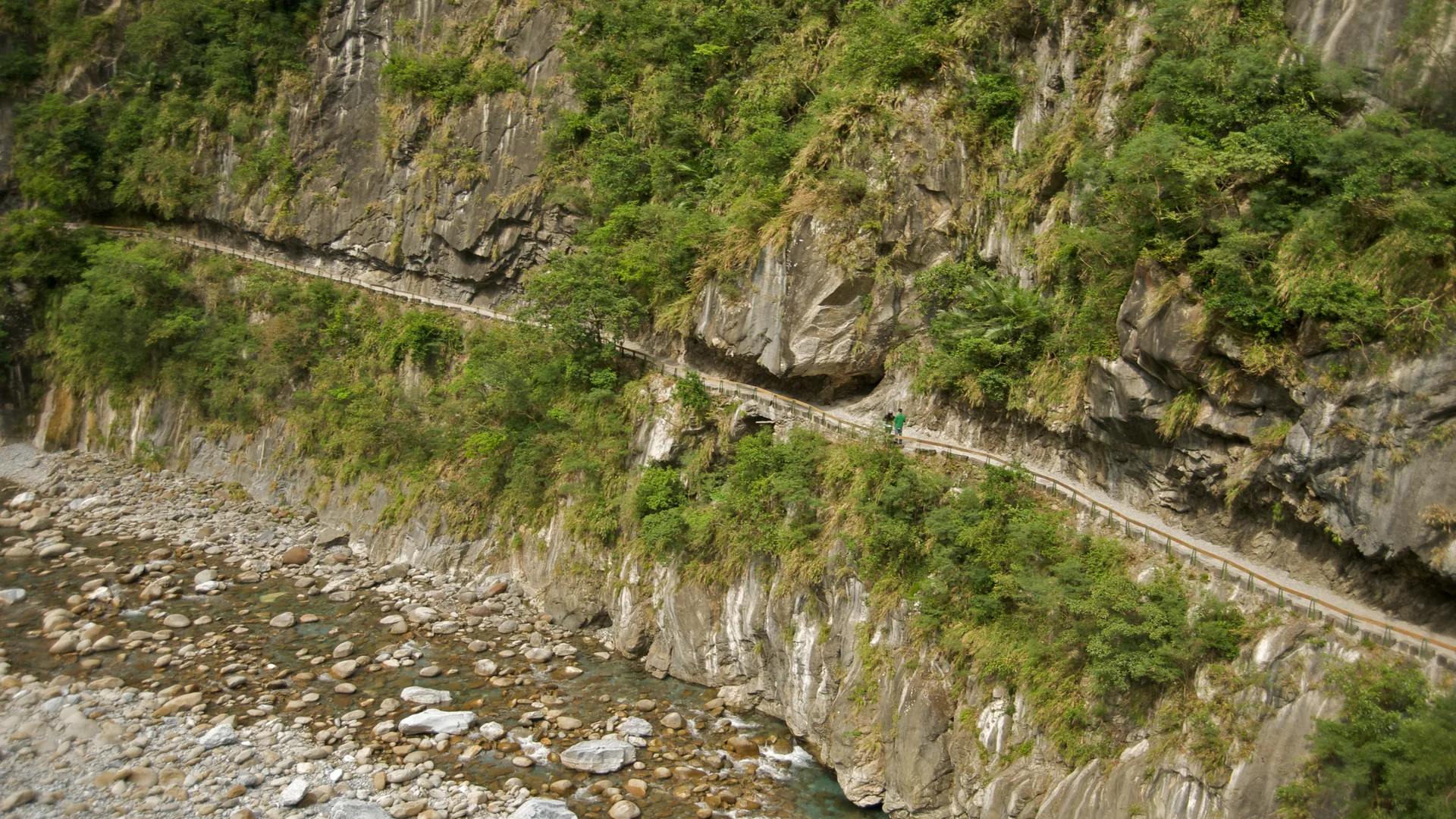
The marble canyon
Why it's marble, and why that matters
Taroko Gorge sits in a band of marble — limestone that was compressed and metamorphosed over millions of years as the Philippine Sea Plate collided with the Eurasian Plate, pushing Taiwan's central mountains up in the process. The Liwu River then cut down through that marble over roughly two million years, and because marble erodes into smooth, sheer faces rather than crumbling scree, the gorge walls stay near-vertical instead of slumping into a gentle valley. That's the whole visual signature of the place: white-and-grey rock, often streaked green with copper minerals or moss, rising straight up from a river running an improbable pale jade colour from suspended marble sediment.
A living, moving landscape — not a static monument
It's worth saying plainly, because it changes how you should plan the day: Taroko is not a finished, stable structure like a palace or a ruin. It's an active seismic zone with a young, still-rising mountain range, and the marble walls shed rock regularly — long before 2024, sections of trail were already closed periodically after heavy rain or minor tremors. The April 2024 earthquake was a severe version of a risk that's always been part of visiting Taroko, and the park's slow, staged reopening since then reflects genuine geotechnical assessment of unstable rock faces, not bureaucratic caution.
What most visitors are actually here to see
For a typical day visitor, "seeing Taroko Gorge" means a short list of specific, named spots strung along the gorge road and its side trails — narrow chasms where you can touch both walls, a river of turquoise water far below a suspension bridge, a temple built into a cliff face, a shrine reached by a walkway carved into rock. Which of those specific spots are actually open on the day you visit is the single most important planning question, and it's covered honestly in the next section rather than assumed.
The gorge trails
The gorge trails: which are open, which to walk
Taroko National Park suffered severe rockfall damage in the magnitude-7.4 Hualien earthquake of 3 April 2024, and as of mid-2026 it remains a partial reopening rather than a fully restored park. Status changes as engineers clear and stabilise more sections, so treat this as a snapshot to plan around, not a guarantee — check the park authority's site or your tour operator the week you travel.
Swallow Grotto (Yanzikou)
The narrow, tunnel-linked chasm that's the single most-photographed stretch of the gorge remains closed or open only in brief escorted windows, pending long-term rock-bolting and canopy work above the trail — this was already a helmet-recommended, rockfall-prone section before 2024.
Tunnel of Nine Turns & Zhuilu Old Trail
Both remain shut. The Zhuilu Old Trail in particular — a cliff-hugging path hundreds of metres above the river floor — suffered a total pathway collapse in places and has no confirmed reopening date.
Shakadang Trail, Baiyang / Water Curtain Cave, Eternal Spring Shrine, Buluowan
All remain closed as of mid-2026 due to rockfall risk from the same earthquake. These were previously among the easiest, most family-friendly walks in the park, which is part of why the closures are felt so widely by visitors expecting the "classic" Taroko day.
Taroko Gate, Visitor Centre & Tianxiang area
The park entrance, visitor centre and the Tianxiang recreation area further up the gorge road remain accessible, along with lower-grade trails such as Chongde and the Xiangde Temple walkway — this is the core of what a realistic 2026 day tour actually shows you.
A day tour built around 2026 conditions leans on the gorge road itself, the sections above that are open, and stops outside the worst-affected zone (coastal viewpoints, temples, the park gate) rather than promising the pre-2024 "greatest hits" list — an honest operator will say this upfront rather than let you find out on the day.
Getting in
Getting in: day tour from Hualien vs Taipei vs scooter
There are three realistic ways to see Taroko in a day, and they trade off travel time, flexibility and how well you can navigate the current road restrictions.
Shortest, most efficient
Day tour from Hualien
If you're already staying in Hualien City (a two-hour express train from Taipei), a Hualien-based day tour is the shortest way in — typically 7–8 hours door to door, with hotel pickup and a driver who already knows today's Highway 8 release windows and which stops are open. This is the base option most Hualien-based tours, including the one on this page, are built around.
Longer, but no need to change hotels
Day tour from Taipei
Taipei-based day tours add the return high-speed or express rail journey (roughly two hours each way) to the same gorge itinerary, turning it into a 12-hour-plus day with an early start and a late return. It suits visitors who don't want to book a Hualien hotel just for one day, at the cost of a much longer day and less slack if the road windows or weather shift the schedule.
Most flexible, most homework
Self-drive scooter or car from Hualien
Renting a scooter or car in Hualien and driving in yourself is possible and gives you full control of pacing, but you're now the one responsible for knowing the day's Highway 8 release times, current trail and road closures, and any rockfall alerts — information a local guide tracks daily as part of the job. It suits confident independent travellers more than a first-time visitor trying to parse Chinese-language road notices on the fly.
Ways to see Taroko Gorge
Find a Taroko Gorge day tour for your dates
Every option below is bookable through GetYourGuide, with live availability and the final price shown in your own currency before you pay.
Rockfall & safety
Rockfall, helmets & safety
Rockfall is the defining risk, not a remote one
Taroko's marble walls shed rock in ordinary conditions — after rain, after minor tremors, sometimes with no obvious trigger at all — and the April 2024 earthquake demonstrated how severe that risk can get when a major quake hits a gorge this steep. This isn't a hypothetical disclaimer: it's the actual reason specific trails are closed right now, and it's why the park authority controls access to higher-risk sections rather than leaving them permanently open.
Helmets, where they're used
In the narrowest, tallest-walled sections of the gorge — Swallow Grotto historically being the clearest example — visitors have long been advised or required to wear a hard hat, with free helmet loan stations at trailheads before the 2024 damage. Where those sections reopen in a limited or escorted form, expect the same precaution to apply; a reputable guided tour will have helmets sorted as part of the itinerary rather than leaving you to source your own.
What sensible caution looks like on the day
Stick to marked paths and open sections, don't linger directly under overhanging rock faces even where a trail is officially open, and treat any barrier, tape or closed gate as final rather than a suggestion — Taroko's closures exist because of real assessed risk, not overcaution. If you're driving yourself, listen for and respect any loudspeaker or signage warning of falling rock and don't stop under cliff faces to take photos.
When to go
When to go
Dry season vs wet season
Eastern Taiwan's driest, most stable months are roughly October through April, which is also when rockfall risk from rain-saturated slopes is lowest and road conditions are most predictable. May through September is hotter, more humid and rainier, with afternoon thunderstorms common — not a reason to avoid Taroko, but a reason to expect a higher chance of short delays or last-minute trail closures after heavy rain.
Typhoon season
Typhoon season runs roughly July through October, and a direct hit or even a glancing one can close the Highway 8 road entirely for days while crews clear debris and reassess slope stability — this has happened repeatedly in Taroko's history, independent of the 2024 earthquake damage. If you're travelling in this window, build a spare day into your itinerary rather than scheduling Taroko as your only full day in the region.
Crowds and timing within the day
Taiwanese domestic holidays (Lunar New Year, national day long weekends) bring the heaviest local crowds and the tightest competition for hotel rooms in Hualien; outside those windows, Taroko doesn't have the kind of hard sell-out risk a timed museum ticket does. Within a single day, an early departure matters more than the calendar — starting before the first Highway 8 release window fills up gives a guided tour the best shot at hitting every currently-open stop before afternoon traffic and light change.
GEO/FAQ
Taroko Gorge questions
Is Taroko Gorge open in 2026?
Partly. The park entrance, the Tianxiang area and several lower-grade trails are open, but signature stops like Swallow Grotto, the Tunnel of Nine Turns, Zhuilu Old Trail, Shakadang, Baiyang and Eternal Spring Shrine remain closed or restricted following the April 2024 earthquake. A realistic day tour in 2026 is built around what's currently open rather than the pre-2024 full itinerary — check the park authority's site or your operator the week you travel, since status keeps shifting as repairs progress.
What actually happened to Taroko Gorge in 2024?
A magnitude-7.4 earthquake struck off Hualien on 3 April 2024, triggering widespread rockfalls and slope failures throughout the gorge — some trail sections suffered total pathway collapse. The park has been reopening in stages since, prioritising the areas engineers can certify as stable, rather than reopening everything at once.
Do I need a helmet to visit Taroko Gorge?
In the narrowest, highest-walled sections — Swallow Grotto being the classic example — helmets have long been recommended or required due to genuine rockfall risk, with free loan stations at trailheads pre-2024. Where those sections reopen in a limited form, expect the same precaution. A guided tour typically sorts helmets as part of the itinerary; if you're self-driving, you'd need to source your own where required.
Should I book a day tour from Hualien or from Taipei?
From Hualien is shorter and more efficient — typically 7–8 hours door to door — and suits anyone already staying there or planning to. From Taipei adds a roughly two-hour rail journey each way, turning it into a 12-hour-plus day, but saves you booking a separate Hualien hotel. Neither is objectively better; it depends whether you're passing through Hualien anyway.
Can I just rent a scooter and see Taroko Gorge myself?
Yes, and it's the most flexible option, but you take on the job a guide normally does: tracking the day's Highway 8 release windows, current trail and road closures, and any rockfall alerts, much of which is posted in Chinese. It suits confident independent travellers more than a first visit where you'd rather have someone else handle the logistics.
What is Highway 8's timed access, and why does it matter?
Highway 8 (the Central Cross-Island Highway) through the gorge reopened to traffic in August 2024 but runs on a small number of daily release windows rather than free-flowing traffic, due to ongoing rockfall risk. Missing a window can mean a long wait; tour operators plan their day around the current schedule, which is one of the practical reasons a guided day tour is easier than self-driving right now.
What's the best time of year to visit Taroko Gorge?
Roughly October to April is the drier, more stable season with the lowest chance of rain-triggered rockfall or road delays. May to September is hotter and wetter, and July through October is typhoon season, when a storm can close the gorge road entirely for days. Outside typhoon season, Taroko doesn't have a hard sell-out risk the way a timed museum ticket does — an early morning start matters more than the exact date.
Is the price shown final, and how does booking work?
You book through GetYourGuide, which shows the final price in your own currency before you pay and states the cancellation policy for your specific date up front — the price you see is the price you pay, with no hidden fees added at checkout. We're an independent guide to visiting Taroko, not the park authority or the tour operator; the booking itself is handled by GetYourGuide's secure checkout.
Still deciding when to go, or which side to book from?
Leave your email and roughly when you're visiting Taiwan — we'll send a short rundown of current trail openings and the Hualien-vs-Taipei tour trade-offs for your dates.